Packing guide
Pack once, clear customs once
A box that is sound, labelled and listed gets through customs and the ocean without trouble. These are the rules we pack by.
Cartons we supply in Taiwan
| Size | cm | CBM | NT$ | Best for |
|---|---|---|---|---|
| Small | 45 × 30 × 25 | 0.04 | 40 | Heavy items — books, magazines |
| Medium | 50 × 40 × 30 | 0.06 | 55 | Light items — small appliances |
| Large | 60 × 50 × 40 | 0.12 | 75 | Light items — clothes, bedding |
Five-layer corrugated cartons, supplied for shipments from Taiwan only. To order: email or phone us with the sizes, quantity, delivery address and contact; we send the total and bank details; once payment is received we courier the cartons (NT$300 per 10 cartons, delivered to the ground floor, not carried upstairs), or you can collect them from our office. To order cartons, call our Keelung warehouse: +886 2 2452 7669. Cartons are cut in batches, so sizes can vary by up to 1 cm.
Never use recycled boxes such as fruit or rice cartons. Customs can read them as commercial goods and open the box or charge duty.
Sealing and labels
- Seal every box so nothing can fall out. Use polypropylene or vinyl tape. Avoid cellophane, paper-backed, masking or household tape, and string.
- Tape the top and bottom each with at least 3 strips, covering every seam and flap edge (H-seal). Tape 5–7.6 cm wide.
- Put two shipping marks on every box, one centred on each of the two long sides, three lines each: your full English name as in your passport (surname and given name, the same on every box, not the surname alone), the box number as NO. total-number (for example NO. 10-01 for box 1 of 10), and PERSONAL EFFECTS. The box number must match the first column of your packing list. Label maker and templates (Chinese) →
- Remove or cross out old shipping labels.
- Put a slip inside each box with the consignee's full address.
- Customs may open a box; we repack to the same standard afterwards.
Packing list and invoice
- List the contents of every box. “Misc.” invites inspection.
- Shipping back to Taiwan: write used goods as “Used Personal Effects” and value as “No Commercial Value”. Shipping to the US: list every item in English with an estimated value instead.
- Give each large item a value and, for used items, years of use.
- Pack a box of everyday essentials last so it is easy to find on arrival.
Palletising
Cartons going by sea are usually stacked on a pallet, wrapped, and measured at the dock. Freight is charged on the finished pallet — length × width × height — so a tall pallet measures more than the cartons inside it. We stack cartons in an interlocking pattern, heavy ones at the bottom, and keep the pallet within the carrier's height limit.
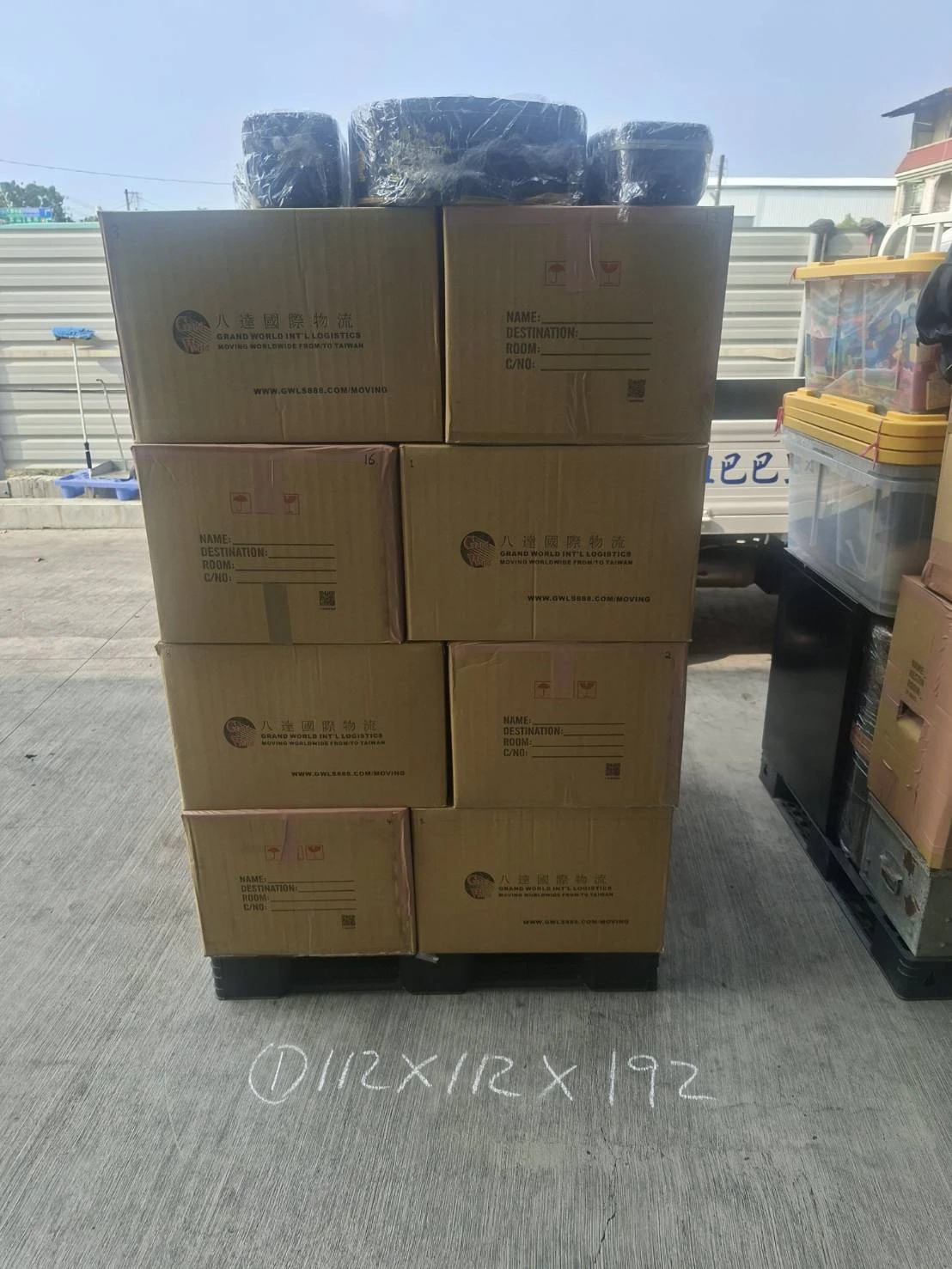
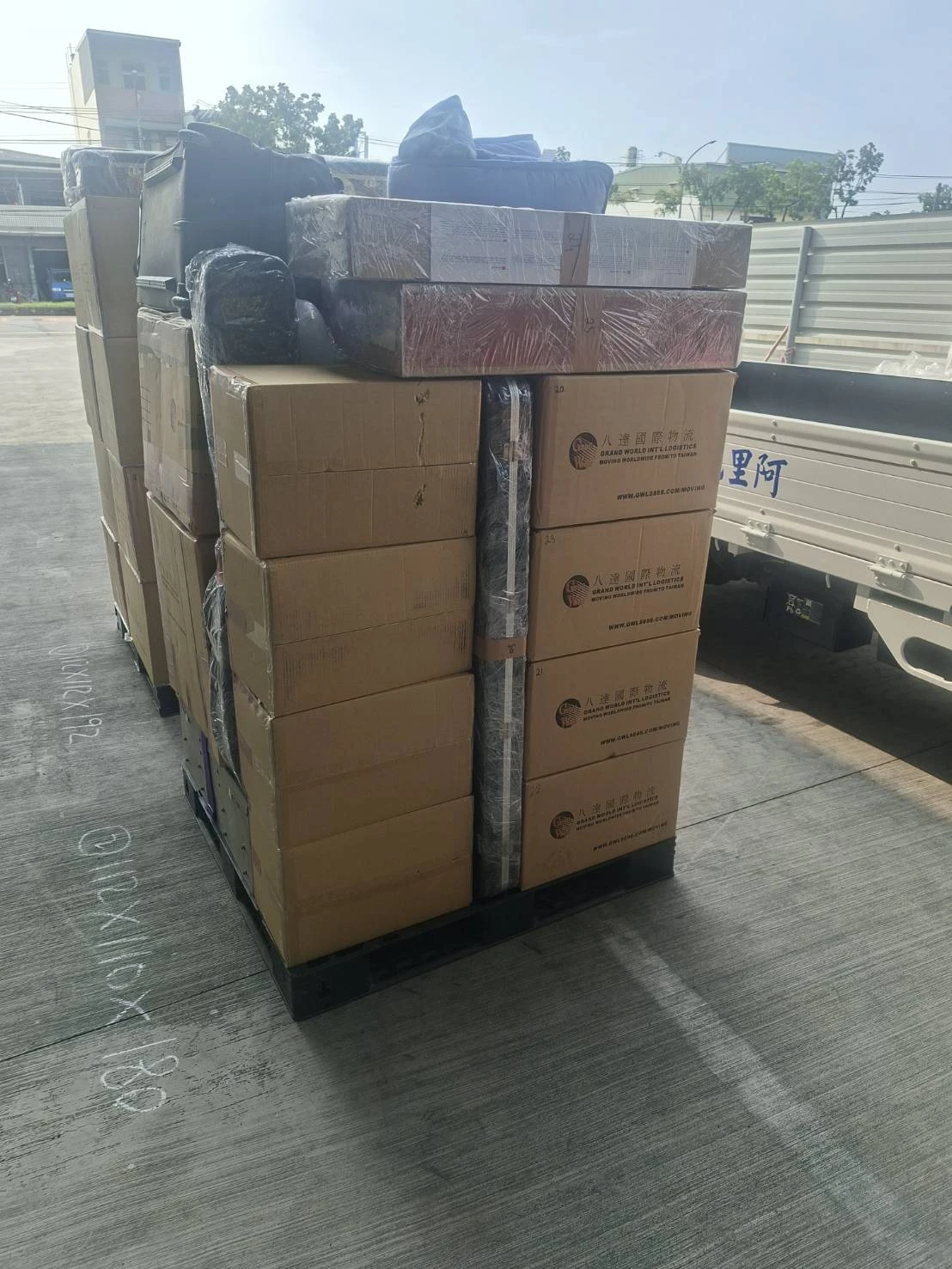
Examples of finished pallets. Your own pallet will differ with the size and number of boxes.
Special items
Furniture, sofas, wardrobes
Fine-packed or built into a wooden crate. Carriers will not take bare furniture.
Pianos
Crated for export. See the photos on the home page.
Glass and crystal
Wrap in bubble wrap and place in a box inside a box.
Framed art
Tape an X across glass or acrylic panels with masking tape before wrapping.
Monitors
Remove the stand and accessories; ship screen down where possible.
Engines, motorcycles
Drain every fluid and plug fuel lines and dipstick openings before packing.
Suitcases and soft bags
Add an outer layer so labels do not mark or tear them. Damage from unprotected luggage is not covered.
Photocopiers
Remove toner and bag it; tape moving parts; pack paper trays separately.
Wood packaging
Crates, pallets and supports must be heat-treated to ISPM 15 and carry the IPPC mark, or the shipment can be refused or fumigated at the destination.
Wooden crates must stand on skids. Skids are the wooden feet under a crate. They leave a gap for the forklift forks, so the crate can be lifted at the warehouse, loaded into the container and unloaded at destination. A crate built flat to the floor cannot be forklifted: it has to be set on a pallet or moved by hand, which costs time and labour and puts the contents at risk.
Not everything can go: what cannot be shipped
These rules apply to every destination. A banned item found during inspection can hold the whole shipment, and the storage and inspection charges fall on the owner.
Dangerous goods: never
- Batteries of any kind: lithium batteries, power banks, spare batteries
- Aerosols and pressurised cans: sprays, hairspray, insect repellent spray, gas canisters, fire extinguishers
- Flammables and explosives, including anything containing alcohol: perfume, nail polish, nail polish remover, rubbing alcohol, lighters, matches, paint, thinner, petrol, fireworks
- Other hazardous goods: bleach, strong acid or alkaline cleaners, chemicals, gas cylinders
Carry laptops, phones and cameras with built-in batteries with you. Ask us first about power tools, e-bikes and anything else with a large battery.
Food, farm products, tobacco and alcohol: no
- Meat, eggs, milk and dairy products
- Fruit, vegetables, grains, dried goods and other food
- Plants, seeds and soil
- Tobacco and alcohol: no duty-free allowance, and each country has its own permits
Medicine, supplements and cosmetics: carry them with you
We do not refuse them for our own sake. Medicine and supplements are controlled by the food and drug authority of the importing country, such as the US FDA or Health Canada, so in a sea shipment they often cannot clear, and the goods sit in the warehouse running up storage and inspection charges. Carry them with you, with the prescription or an English label. Cosmetics and skincare can be restricted for their ingredients, so carry those too.
Keep valuables with you, never in goods to follow. Wedding rings, diamond necklaces, gold jewellery, watches, cash and other small, high-value items, and anything unique that cannot be replaced, such as heirlooms, should travel in your hand luggage. A sea shipment passes through pickup trucks, warehouses, the port and the container yard, and customs at both ends may open the boxes. With that many hands and places across two countries, a small item that goes missing is almost impossible to trace, and it is hard even to know where to report it.